5 contributions of digital technology in the logistics sector
28 September 2021


28 September 2021
Never before have so many packages been delivered on Earth, and the last few months have accentuated the phenomenon. Such an evolution in demand forces the logistics sector to adapt its organization to keep up with the change. Already alert to the transformation of the industry into a fourth generation, it is becoming necessary to digitize logistics tools to keep pace.
In an increasingly volatile global environment (VUCA), digital transformation is no longer just an option for optimization—it is the driving force behind resilience. Supply disruptions, fluctuating transportation costs, and new environmental requirements are pushing operations managers and CIOs to rethink their models. How does technology enable the transition from a reactive cost center to a predictive, value-creating ecosystem? Discover the 5 fundamental ways digital technology can revolutionize your supply chain management.
The first challenge for a modern Supply Chain is to break down data silos. Historically fragmented, information management leads to costly blind spots. Today, digitalization makes it possible to establish a virtual control tower that centralizes data in real time.
Use case: IoT (Internet of Things) tracking combined with blockchain ensures flawless traceability of products, from the factory to the end customer.
The concrete impact: Managers can anticipate bottlenecks in logistics flows, guarantee the authenticity of goods, and react instantly in the event of a product recall.
Gone are the days when supply was managed solely based on sales history. Today, AI (Artificial Intelligence) and Machine Learning analyze millions of variables: market trends, weather, geopolitical events, and consumer behavior.
The concrete impact: These algorithms generate demand forecasts with unprecedented accuracy. They enable dynamic inventory optimization, reducing both overstocking (tied-up capital) and stockouts (loss of revenue). According to recent industry studies, AI applied to inventory management can reduce storage costs by 15 to 20%.
Low-value-added human intervention is a source of errors and delays. The automation of robotic process automation (RPA) and repetitive tasks is transforming operations management.
Use case: Order entry, invoice reconciliation, and triggering restocking alerts are managed by intelligent workflows.
The concrete impact: Field and administrative teams are freed from time-consuming tasks to focus on strategic analysis and exception management. The warehouse itself becomes “smart” with the integration of AGVs (automated guided vehicles) connected to central systems.
Business needs evolve faster than traditional IT development cycles. Deploying a scalable and composable platform has become a competitive imperative.
The concrete impact: Integrating no-code or low-code building blocks allows business managers to create or adapt management applications without needing to code. Whether it’s adding a new quality control step or modifying a shipping rule, this approach offers total flexibility. The time-to-market for new internal solutions is reduced from several months to a few weeks, or even a few days.
Regulatory pressure (CSRD in Europe) and consumer expectations require measuring and reducing the carbon footprint. Digital technology is the ultimate diagnostic and action tool for building sustainable logistics.
The concrete impact: Data analysis enables the optimization of transport route plans, maximizes truck load factors, and minimizes empty returns. Digital Twins simulate different supply scenarios to identify the route with the lowest CO2 emissions while meeting delivery deadlines.
Integrating new technologies into the Supply Chain is no longer a matter of IT modernization, but a strategic survival issue. From real-time visibility to artificial intelligence and agile platforms, digital technology equips companies with the tools needed to anticipate rather than react. Tomorrow’s leaders will be those who have successfully transformed operational constraints into an interconnected, sustainable, and highly resilient ecosystem.
What is a digital supply chain? It is an interconnected ecosystem where all processes (procurement, warehousing, transportation, delivery) are managed and optimized through the collection and analysis of real-time data.
How does digital technology improve inventory management? Thanks to predictive analytics and AI, systems anticipate peaks or drops in demand. This allows for maintaining optimal inventory levels in the right locations, thereby reducing costs and the risk of shortages.
Why use no-code in logistics operations management? No-code allows business teams (logistics professionals, warehouse managers) to customize their tools and workflows quickly and independently, without relying on a lengthy IT development cycle.
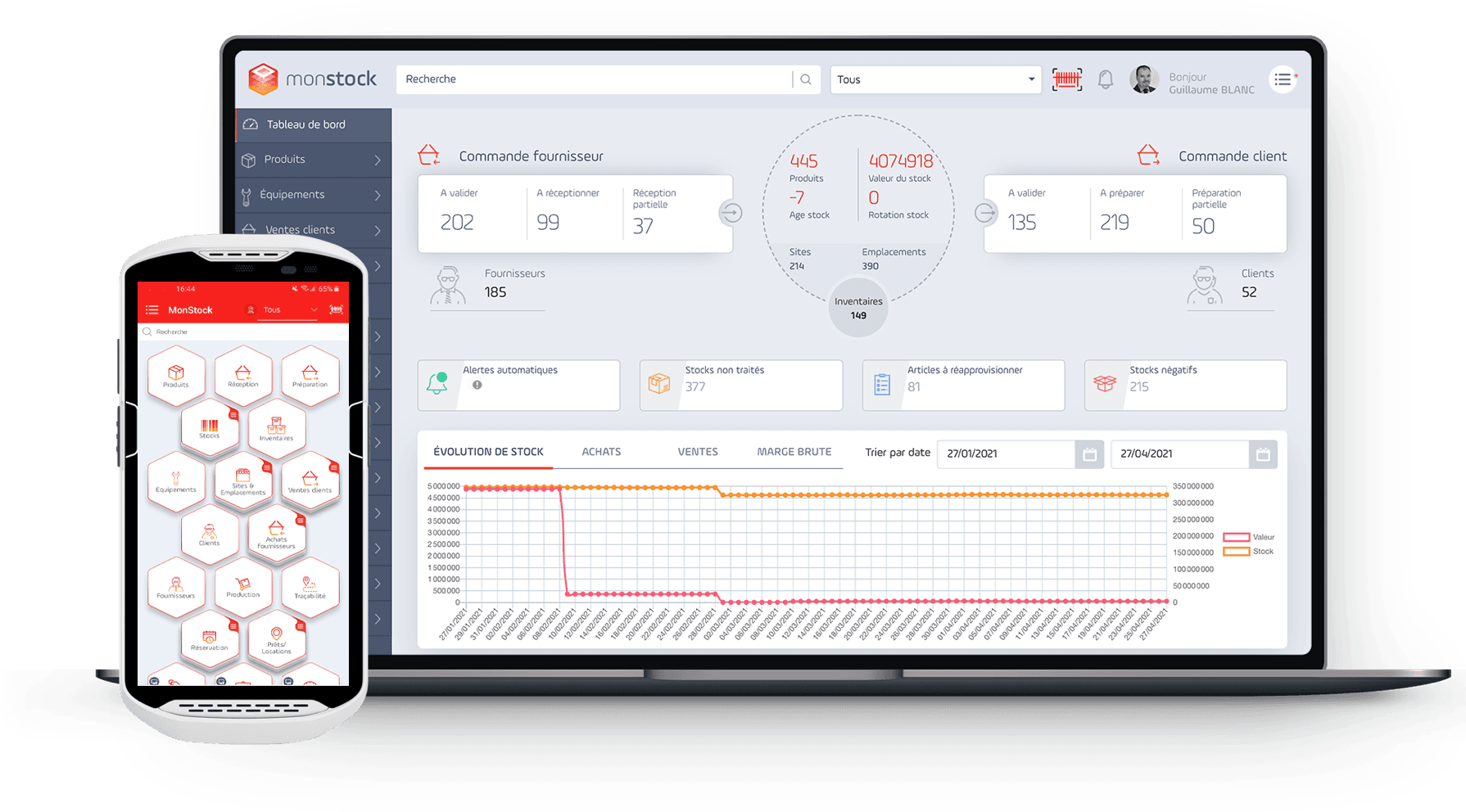
Representation of the mobil and webstite Monstock solution
The digital transformation forces all players to take agile solutions (Smart Supply Chain) to adapt quickly. To achieve high efficiency and expand into new spaces that were not necessarily thought or organized for their activity, it is now essential to digitize all processes.
Monstock is alert to the challenges and needs of companies (traceability, extended supply chain, flow control, planning, artificial intelligence, etc.) and offers a digitalized solution for inventory and flow management (Smart Supply Chain), which provides a complete and innovative solution to satisfy your customers, partners and suppliers.
You want to know more : Contact the Monstock team
Sign up for our newsletter today